English
 Français



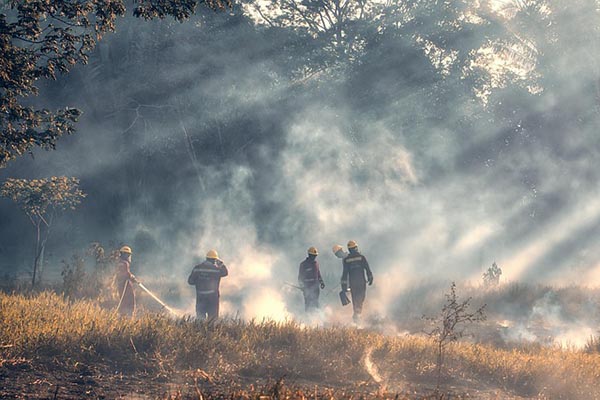
Causes of wildfires
Wildfires are often accounted for by natural phenomena such as volcanic eruptions, lightning, drought and extreme temperatures.
However, with the evolution of human activities and increasing urbanization, fires of human origin (arson, unattended fires or loss of control of planned burns) have become more frequent.
Natural causes
Forest fires can originate from natural “activity”:
- a volcanic eruption or earthquake, which usually occur in very specific geographical areas,
- lightning, the main cause of forest fire starts, is responsible for around 2% of fires in Mediterranean areas and almost 30% in Quebec,
- favorable weather conditions: dry thunderstorms, dry and warm air (sirocco).
Ces causes naturelles sont beaucoup moins fréquentes que les incendies d’origine humaine. Elles représentent moins de 10% des départs de feux de forêt.
Human causes
According to the World Organization for the Protection of the Environment (OMPE), 9 out of 10 fires are of human origin, mainly due to carelessness. Other deliberate or malicious acts can also trigger fires, such as:
- Accidents and carelessness: poorly extinguished campfires, cigarettes thrown on the ground, fireworks, garbage dumps and littering (1) are all incidents that can spark fires. Carelessness accounts for 43% of human-caused forest fires,
(1) An ancestral agricultural technique also known as “clearing by fire”, which consists of pulling up vegetation and the surface layer of humus, incinerating these elements in small piles, then spreading the ashes on the land to enrich it with nutrients. - Illegal deforestation and slash-and-burn: these are agricultural practices involving the burning of forest plots for subsequent cultivation,
- Incidents involving power lines: faulty equipment can generate sparks and cause fires, such as:
- the Dixie Fire (California) on 13 July 2021. The fire was triggered when a tree hit a power line belonging to Pacific Gas and Electric (PG&E). Consequences: 275 000 hectares burned, the village of Greenville razed to the ground and over 1 300 properties destroyed,
- the Zogg Fire (California) on 27 September 2020, and the Tubbs Fire (California) in October 2017 also caused by power lines.
- Criminal acts: some fires are the work of arsonists or deliberately set for criminal reasons,
- Construction in high-risk areas: increasing urbanization near forests amplifies the risk of forest fires,
- Incendiary policies: some countries chose to clear virgin forest to make way for agricultural activities and grazing land. This is the case in:
- Brazil, which resorts to these practices to develop its livestock and soybean cultivation,
- Indonesia, for the expansion of oil palm cultivation.
- Lack of forest management is often behind major fires.
Read also | Wildfires: a threat to insurers
The aggravating role of global warming
Climate change, manifested mainly in rising temperatures, drought and severe, long-lasting heat waves, is amplifying the risk of forest fires, increasing their frequency, size and extent.
On a global scale, the rise in average temperatures recorded over recent decades is one of the most obvious signs of global warming. The 2015–2024 period has been the hottest on record worldwide.
According to the World Meteorological Organization, the average temperature recorded in 2024 was some 1.26°C higher than in the pre-industrial period. The same year also saw an additional 41 days of dangerous heat for people's health (the elderly, the sick, etc.).
The increase in forest fires is also the logical consequence of the drought that is setting in in several countries: increasingly hot summers, water deficit, declining rainfall, etc.
In addition, the El Niño phenomenon (1) is creating an environment conducive to the intensification of forest fires in the “dry corridor (2)” of Central America, northern South America, Australia and East Africa. These hot, violent winds are behind the spread of fires, making them even more frequent, destructive and difficult to control.
In addition, an overload of fuel, due to the accumulation of dry vegetation after long periods of drought, makes forests even more vulnerable to fires that occur during unusual seasons.
In 2024, for example, the total number of fires and areas burnt was higher than the average for the last five and ten years. In the USA alone, there were 64 897 forest fires. The Brazilian Amazon set a new record, with 140 328 fires reported during the year.
(1) The El Niño phenomenon refers to an alteration in the interrelationships between ocean and atmosphere, with changes in sea surface temperature affecting winds and rainfall, causing numerous climatic upheavals.
(2) Central American Dry Corridor: geographical area comprising a tropical dry forest ecosystem stretching from southern Mexico to Panama.
Read also | Major wildfires: 2015-2024
Consequences of wildfires
Forest fires cause major damage to people's health and property. The ensuing economic, environmental and social costs are staggering.
Physical and mental health
In addition to direct deaths and injuries, fires also have an impact on human health. Large quantities of greenhouse gases are released into the atmosphere by fires, causing air pollution from smoke and contamination of soil, surface water and groundwater from ash.
According to the Australian Health and Medical Research Council, 1.53 million people die every year worldwide due to air pollution caused by wildfires.
More than 8.6 billion tons of carbon dioxide (CO2) were emitted by forest fires between March 2023 and February 2024 worldwide.
In Canada, these emissions, nine times higher than the average for the last two decades, forced more than 232 000 people to evacuate their homes between 2023 and 2024.
Psychological trauma can also occur, particularly in communities that have lost their homes, or those often subject to evacuation or relocation orders.
Environmental damage
In environmental terms, fires destroy large areas of vegetation, deteriorate air quality, damage biodiversity and compromise endangered animal species.
Damage to the Ecosystem
The loss of agricultural production, the decline in tourism, the destruction of residential areas and industrial, mining and forestry facilities are all threats that undermine the economic activity of a region affected by forest fires.
The region's vital ecosystems are put to the test, with a particular impact on infrastructure (roads, electricity and telecommunications networks, ...).