Français
 English



Silk Road Insurance Forum 2026: From strategy to execution in a transforming market

The Silk Road Insurance Forum, held on 25 March 2026 in Istanbul, brought together senior leaders from across the insurance ecosystem to discuss one of the industry's most urgent questions: how to move from strategy to execution in a rapidly changing world.
Hosted by Remed Global, with the support of Insurance Association of Türkiye, the forum took place at the Mandarin Oriental Bosphorus and welcomed more than 200 participants from more than 20 countries, including insurers, regulators, insurance associations and technology providers from across the Silk Road region.
Economist and author Murat Sağman provided a concise overview of the regional financial landscape, outlining macroeconomic outlooks and key market scenarios ahead, while highlighting emerging risks and opportunities for the insurance sector.
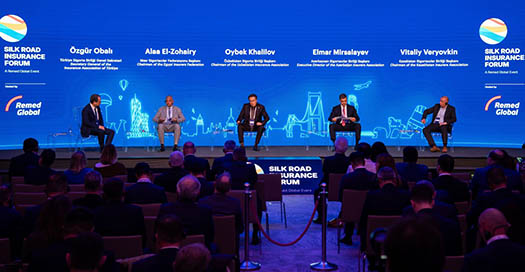
The forum featured a strong line-up of speakers from across the region, including Uğur Gülen (Chairman, Insurance Association of Türkiye), Alaa Al-Zohairy (Chairman, Egypt Insurers Federation), Oybek Khalilov (Chairman, Insurance Association of Uzbekistan), Elmar Mirsalayev (Executive Director, Azerbaijan Insurers Association), Vitaliy Verevkin (Chairman, Kazakhstan Insurers Association), and Sabine VanderLinden (CEO, Alchemy Crew Ventures), alongside many other senior executives, regulators, and industry experts.
Regional perspectives: growth, reform and digital acceleration
Discussions with insurance association leaders from across the Silk Road region highlighted a shared direction: strong growth potential supported by regulatory reform, increasing awareness and rapid digitalisation.
In Egypt, Alaa Al-Zohairy presented one of the most striking transformation stories. Over the past eight years, the market has grown from EGP 22 billion to over EGP 100 billion, driven not only by product development but by a deliberate strategy to increase insurance awareness and accessibility.
Initiatives such as nationwide campaigns, microinsurance products reaching 11 million policies, and the integration of travel insurance into passport processes have significantly expanded market reach.
The Egyptian model demonstrated how coordinated action between regulators, insurers and public institutions can rapidly scale penetration.
In Central Asia, Oybek Khalilov described Uzbekistan as entering a “renaissance phase”. The market has grown tenfold over the past decade, with annual growth rates exceeding 30%, while penetration remains at just 0.7%.
This combination of growth and under-penetration signals substantial upside potential. At the same time, the country is accelerating digital transformation through mandatory electronic policies and the early adoption of AI in underwriting and fraud detection. Cyber insurance was identified as a key untapped opportunity.
In Kazakhstan, Vitaliy Verevkin highlighted a shift toward data-driven transformation. The market recorded 20-25% growth, while a fully integrated national insurance database — connected to 95 government systems — is enabling real-time access to policy and claims data.
The adoption of AI in claims assessment is already improving efficiency and fraud detection. At the same time, comprehensive regulatory reform is underway, with a particular focus on developing compulsory insurance solutions for natural catastrophe risks.
Azerbaijan reflects a more stable but steadily developing market. According to Elmar Mirsalayev, the sector reached $884 million in premiums, growing by 11%, with claims rising by 22%. Growth is being supported by core lines such as motor, health and property insurance, alongside a clear strategic focus on improving insurance literacy and advancing regulatory and digital infrastructure.
Across these markets, a consistent pattern emerged: growth is no longer driven solely by economic expansion, but by regulation, data infrastructure and ecosystem collaboration. While each country is at a different stage of maturity, all are moving toward the same objective — building more accessible, technology-enabled and resilient insurance systems.
TechBridge: smart and accessible insurance
The forum's afternoon sessions moved from strategy to execution, offering a clear view of how technology is already transforming the insurance value chain. In his presentation, Murat Yeşil from SAS, outlined four scenarios shaping the industry through 2040, with a strong focus on data, predictive analytics and AI-driven decision-making.
This forward-looking perspective was complemented by Metin Serhat Atayeter from Google AI, who demonstrated how cloud-based AI solutions are enabling insurers to modernise underwriting, claims management and customer experience in real time.
A standout moment of the forum was the TechBridge session, moderated by Okan Utkueri, which brought together eight of Türkiye's leading insurtech innovators. Companies such as Ekmob, Lumnion, Comodif, Alber Health, Wyseye, Seatech, and Exarion demonstrated practical, scalable solutions across the insurance value chain.
The session highlighted real-world applications including telematics-based motor insurance, connected vehicle ecosystems, AI-powered underwriting and fraud detection, as well as digital distribution and embedded insurance models. Moving beyond theory, TechBridge provided clear evidence that innovation in Türkiye is not only accelerating, but also reaching a level of maturity where solutions can be deployed and scaled across multiple markets.
Closing the capacity gap: why AI is becoming critical
 One of the defining themes of the forum was the growing gap between rising demand and the industry's ability to deliver.
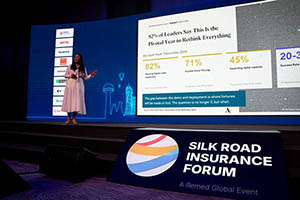
In her keynote, Sabine VanderLinden highlighted a structural challenge: claims volumes are increasing by 15-20% annually, while the workforce is expected to meet only around 70% of future demand. At the same time, up to 25-33% of current tasks could be automated by 2030.
Together, these trends point to a clear conclusion — the industry is facing a 30% capacity gap. Artificial intelligence is therefore no longer a strategic option, but an operational necessity.
One of the most tangible examples of industry transformation is seen in global reinsurance giant Swiss Re's “Agentic AI” strategy. The company has moved beyond using artificial intelligence merely as an analytical tool, evolving it into an active digital partner in underwriting processes.
With cognitive underwriting capabilities, this AI model can process complex risk assessments in seconds, delivering a 40% boost in operational efficiency. This approach demonstrates clearly that AI is no longer just a support tool — it is a strategic teammate capable of bridging capacity gaps.
Meanwhile, Chinese insurance powerhouse Ping An takes the concept of Agentic AI even further. The company resolves >99% of claims in seconds without any human intervention, positioning AI not merely as a tool but as an autonomous operating system managing the full customer-company interaction.
Ping An's approach underlines that speed is no longer just a competitive advantage — it has become a new standard for scalability in insurance.
The transition is already underway, with insurers moving through three stages of maturity: from using AI as a tool, to building human-AI collaboration, and ultimately toward autonomous, AI-driven operations.
From experimentation to execution
Beyond technology, the forum delivered a clear strategic message: the era of experimentation is coming to an end.
The most insurers have invested in digital transformation, but only a limited number have been able to scale these initiatives effectively. The real challenge is no longer innovation itself, but execution.
Industry data shared during the forum reinforced this gap. While 82% of leaders plan to increase investment in AI and digital capabilities within the next 12–18 months, nearly 70% of transformation programmes fail to deliver expected outcomes.
This disconnect highlights a new competitive reality: success will depend less on strategy design and more on the ability to implement and scale.
Embedded insurance: redefining distribution
Another key topic was the rapid emergence of embedded insurance as a new distribution model.
By 2030, embedded insurance in Asia alone is expected to generate $270 billion in premiums, with annual growth rates of 19–30%. By integrating insurance directly into digital ecosystems and customer journeys, these models are set to reshape traditional distribution channels and redefine how insurance is accessed.
Structural barriers: data, talent and leadership
Despite strong growth opportunities, the forum also highlighted three persistent structural challenges.
First, data infrastructure remains fragmented, limiting accessibility and slowing down the effective deployment of AI. Second, the talent gap continues to widen, with 39% of core skills expected to change by 2030, requiring large-scale reskilling across the workforce.
Third, leadership alignment is becoming critical, as AI strategy shifts from a technical topic to a core business priority at CEO level.
As a result, the role of employees is evolving — from executing processes to orchestrating AI-driven systems.
Execution will define the next leaders
The Silk Road Insurance Forum 2026 ultimately pointed to a clear inflection point for the industry.
The next phase of growth will not be driven by ideas alone, but by the ability to execute them at scale. Organisations that succeed will be those that treat data as a strategic asset, embed AI into their core operations, build strong ecosystem partnerships, and move decisively from vision to implementation.
The message from the forum was clear: the future of insurance will be defined not by strategy, but by execution. Ultimately, as TechBridge moderator Okan Utkueri noted, AI transformation is not a disruption to manage, but an evolution to lead.