English
 Français



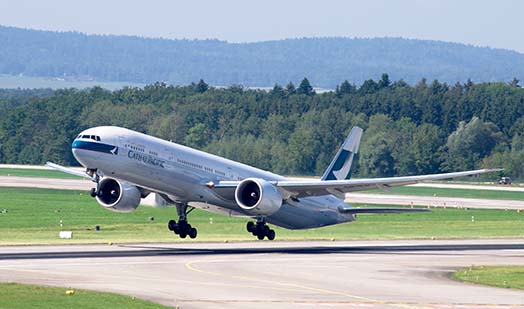
Commercial civil aviation remains today the safest mode of transport in the world, with an extremely low level of risk relative to the volume of flights operated.
This track record is based on a continuous improvement in air safety, driven by technological breakthroughs, the strengthening of international standards and the development of safety management systems.
Despite this favorable trend, the sector remains exposed to rare but potentially very costly events, the impact of which can be significant for airlines and insurers.
Evolution of global air traffic: 2019-2025
Air travel has shown sustained growth momentum thanks to an increase in the number of passengers and flights, a trend abruptly halted in 2020 due to the Covid-19 pandemic.
The health crisis led to an unprecedented contraction in global air traffic because of travel restrictions, border closures, and lockdown measures implemented internationally.
After several years of gradual recovery, the sector returned in 2024 to its pre-crisis level of activity, thus confirming its resilience and ability to adapt to major disruptions.
According to the International Air Transport Association (IATA) annual report, nearly 38.7 million commercial flights were operated worldwide in 2025, carrying approximately 5 billion passengers.
Number of passengers and commercial flights: 2019-2025
| Year | Number of passengers (in billions) | Number of flights (in millions) |
| 2019 | 4.5 | 38.79 |
| 2020 | 1.8 | 22.47 |
| 2021 | 2.3 | 24.92 |
| 2022 | 3.2 | 31.21 |
| 2023 | 4.2 | 35.25 |
| 2024 | 4.528 | 37.09 |
| 2025 | 5 | 38.7 |
Source: IATA
Overall level of safety of commercial flights
Statistically, commercial air travel has a particularly high level of safety compared to other modes of transportation. However, aviation risk is characterized by its extreme severity. A single accident or malfunction can result in significant loss of life, the total destruction of the aircraft, and substantial damage to third parties and on the ground.
This concentration of damage in a single event explains the need for specialized insurance and reinsurance mechanisms capable of absorbing claims of exceptional magnitude.
A total of 51 accidents were recorded in 2025, compared to 54 in 2024. The overall accident rate is 1.32 incidents per million flights; an improvement compared to 2024 (1.42). This level, however, remains slightly higher than the 2021-2025 five-year average of 1.27 accident per million flights (1).
(1) International Air Transport Association 2025 report
Number of accidents and fatalities in commercial aviation: 2019-2025
| Year | Number of accidents | Number of fatal accidents | Number of deaths | Overall accident rate (accidents per million flights) |
| 2019 | 114 | 6 | 239 | 2.94 |
| 2020 | 48 | 4 | 298 | 1.53 |
| 2021 | 48 | 4 | 104 | 1.93 |
| 2022 | 64 | 7 | 160 | 1.34 |
| 2023 | 66 | 1 | 72 | 1.16 |
| 2024 | 54 | 7 | 244 | 1.42 |
| 2025 | 51 | 8 | 394 | 1.32 |
| 2021-2025 average | 44 | 6 | 198 | 1.27 |
| 2016-2025 average | 48 | 7 | 208 | 1.31 |
Source: IATA
Air safety by region
Despite improvements in global aviation safety, performance continues to vary significantly by region.
Over the past five years, Africa has recorded the highest accident rate, with 9.37 incidents per million flights, while North Asia has the lowest rate with 0.18 accidents per million flights.
Accident rate by region
Accidents per million flights
| Regions | 2025 | 2024 | 2021-2025 average |
| North America | 1.68 | 1.49 | 1.33 |
| Latin America and the Caribbean | 1.77 | 1.84 | 2.02 |
| Europe | 1.3 | 1.48 | 1.11 |
| North Africa and the Middle East (MENA) | 0.53 | 1.09 | 1.01 |
| Commonwealth of Independent States (CIS) | 2.74 | 1.44 | 2.26 |
| Asia-Pacific | 0.91 | 1.08 | 0.99 |
| North Asia | 0.16 | 0.16 | 0.18 |
| Sub-Saharan Africa | 7.86 | 12.13 | 9.37 |
| World | 1.32 | 1.42 | 1.27 |
Source: IATA Safety report 2025
Read also | Aviation insurance premiums by region
Total cost of aviation claims in 2025
According to forecasts by Cirium (1), the total cost of aviation claims in 2025 is estimated at 3.406 billion USD. This amount includes physical damage to aircraft as well as compensation for third-party liability and other related coverages.
Three major claims were recorded during that same year, namely:
- The collision between an American Eagle (PSA Airlines) CRJ701ER and a helicopter: On 29 January 2025, an American Airlines plane collided with a military helicopter near Ronald Reagan National Airport in Washington, D.C, with both aircrafts crashing into the Potomac River. The accident claimed the lives of all 64 people on board the plane and the three people aboard the helicopter.
- The Air India Boeing 787-8 crash: On 12 June 2025, shortly after taking off from Ahmedabad Airport (India) bound for London Gatwick, the aircraft lost power in both engines before crashing into buildings on the ground. The accident resulted in 260 deaths, including 241 people on board and 19 on the ground.
- The UPS MD-11F crash: On 4 November 2025, shortly after taking off from Louisville Airport (Kentucky, USA), the cargo plane crashed into an industrial area. The accident resulted in the deaths of the 3 crew members and 12 people on the ground.
These three disasters alone account for more than half of the total losses recorded in 2025.
(1) Cirium is a British company specialized in aeronautical data analysis