English
 Français



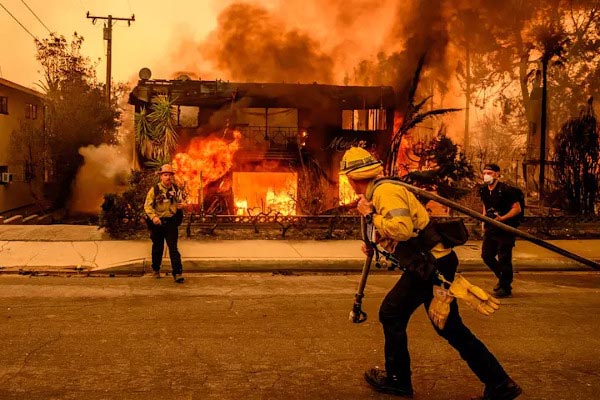
Wildfires are a recurring phenomenon in California. Prolonged droughts, low humidity, hot and dry Santa Ana winds (1), and the construction of homes in high-risk fire zones are among the major causes of wildfires in this region.
The scale and frequency of these disasters continue to increase year after year.
(1) Santa Ana: A meteorological phenomenon that occurs in Southern California between September and March. These are hot, dry winds that often blow as storms along the coast, with speeds exceeding 100 km/h.
Read also | Major wildfires: 2015-2024
List of California wildfires: 2016-2025
Over the past decade, California has recorded nearly 70 000 wildfires, which have ravaged more than 5 million hectares and destroyed nearly 72 000 structures and buildings of all types.
| Year | Number of fires | Area burnt (in hectares) | Deaths | Number of structures destroyed |
| 2025* | 337 | 23 324 | 30 | 16 244 |
| 2024 | 8 024 | 424 925 | 1 | 2 148 |
| 2023 | 7 386 | 134 688 | 4 | 179 |
| 2022 | 7 477 | 134 096 | 9 | 1 279 |
| 2021 | 7 396 | 1 039 795 | 3 | 3 846 |
| 2020 | 8 648 | 1 741 922 | 33 | 11 116 |
| 2019 | 7 148 | 112 213 | 3 | 703 |
| 2018 | 7 948 | 799 290 | 100 | 24 226 |
| 2017 | 9 270 | 647 352 | 47 | 10 868 |
| 2016 | 6 954 | 270 951 | 6 | 1 274 |
* Data as at 31 January 2025
With a record of 9 270 fires, 2017 holds the highest number of wildfires for the 2016-2025 period. In December of that year, strong Santa Ana winds triggered a series of disasters, including the massive Thomas Fire in Ventura County.
As previously mentioned, 2018 was one of the most catastrophic years the region has ever experienced, with a toll of 100 deaths and 24 226 structures destroyed.
In 2020, wildfires fueled by intense thunderstorms, a record heatwave, as well as Diablo (1) and Santa Ana winds destroyed 1 741 922 hectares, more than 4% of the State's total area.
Among the 2020 fires, the "August Complex Fire" made history as California's first "gigafire," with a burned area exceeding 1 million hectares.
California wildfires: January 2025, a new historical record
2025 began with a natural disaster of unprecedented scale. From 7 to 31January, a series of wildfires struck the Los Angeles metropolitan area in Southern California.
Entire neighborhoods, particularly Pacific Palisades and Eaton, were reduced to ashes.
Fanned by strong Santa Ana winds, the fires spread at an exceptional speed, despite the winter weather. It took more than three weeks of intense firefighting efforts to bring the fires under control. The lack of water and the exceptional drought conditions in California severely hampered rescue operations.
The consequences of the 2025 fires have been disastrous, affecting human lives, the environment, the economy, and the insurance industry, marking a tragic turning point in California's history.
Summary of the disaster:
- 337 wildfires,
- 23 324 hectares burned,
- 30 deaths,
- Over 16 000 structures destroyed, including 10 000 homes,
- Evacuation of more than 200 000 people,
- Economic losses estimated between 250 and 275 billion USD by AccuWeather (2) and between 95 and 164 billion USD by UCLA Anderson Forecast (3),
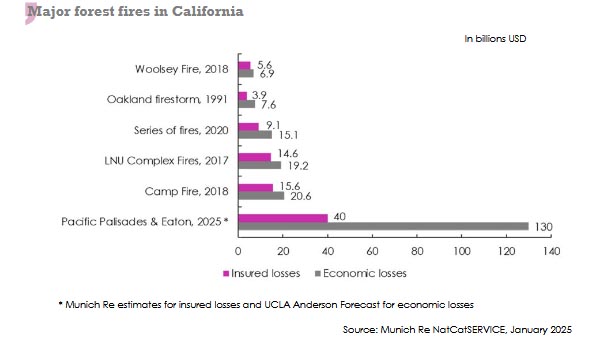
- Insured losses are poised to reach 40 billion USD according to Munich Re and 75 billion USD according to UCLA Anderson Forecast.
The Los Angeles fires completely destroyed neighborhoods housing some of the most expensive residences in the country. Property damage is estimated at several tens of billions of dollars.
According to the American meteorological agency AccuWeather, the total losses could range between 250 and 275 billion USD, or 8% of the State's GDP. This astronomical figure for a single fire includes not only material losses but also costs related to evacuations, business interruptions, emergency housing, healthcare, and reconstruction.
On the other hand, UCLA Anderson Forecast estimates economic losses in the range of 95 to 164 billion USD while insured losses are set at 75 billion USD by the same institution.
The two major reinsurers, Munich Re and Swiss Re, estimate the cost for the insurance market at 40 billion USD.
The 2025 Los Angeles fire has set a new record for natural disaster losses, both for California and the United States. It has become the most expensive wildfire in California's history and the second most costly natural disaster in the country after Hurricane Katrina, which devastated New Orleans in 2005.
(1) Diablo Winds: Hot, dry winds from Northern California's interior that typically occur in the San Francisco Bay Area during spring and fall.
(2) AccuWeather: An American meteorological agency
(3) UCLA Anderson Forecast: An academic department at the University of California, Los Angeles.
Read also | Feux de forêt : une menace pour les assureurs