English
 Français


By the end of 2023, the Middle East reinsurance market had a reduced number of players. This region has witnessed the disappearance of several reinsurers, not the least of which was Arig in 2020, Gulf Re in 2016, Takaful Re in 2016, ACR Retakaful in 2017 and Emirates Retakaful in 2018.
Qatar Re, renamed Antares Reinsurance Company, transferred its headquarters from Qatar to Bermuda in 2014. Finally, Trust Re has slowed its underwriting dramatically in recent years.
After all these changes, the number of reinsurers went from 14 in 2014 down to 7 in 2023. As a result, the premiums written by the market as a whole fell from 2.5 billion USD in 2014 to 1.8 billion USD in 2023.
Severely disrupted by a number of players going out of business, the market has lost a large amount of premiums. Only in 2018 did the market begin to recover, with a marked increase in new business. Reinsurers were able to take advantage of a favorable economic environment and the rate adjustments imposed by industry leaders.
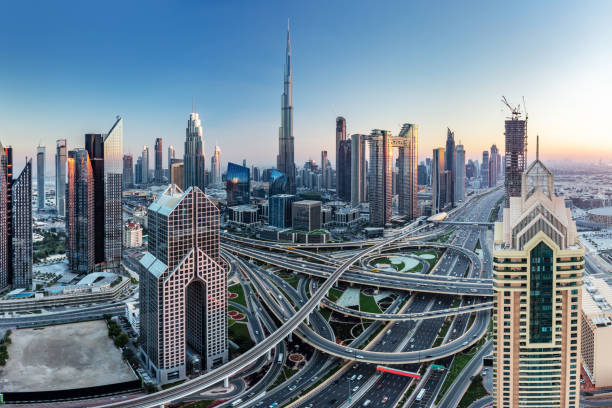
Reinsurance capacity in the region remains high. It is provided not only by local players, but also by foreign operators. The establishment of the Dubai International Financial Centre (DIFC) is playing an important role in the renaissance of the Middle East market.
Middle East reinsurance market: the 2022-2023 business indicators
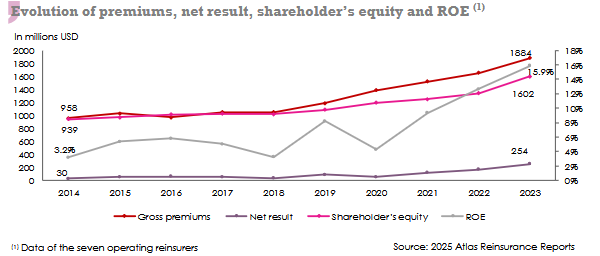
All business indicators are in the green for 2023, with market net result climbing by 50%, from 169 million USD in 2022 to 254 million USD twelve months later.
Shareholders' equity is also rising steadily, reaching 1 602 million USD in 2023, with return rates of 15.9%, a level never reached before.
Figures in millions USD
| 2014 | 2018 | 2019 | 2020 | 2021 | 2022 | 2023 | 2014-2023 evolution (1) | |
| Gross premiums of 7 reinsurers (2) | 958 | 1 047 | 1 191 | 1 391 | 1 522 | 1 655 | 1 884 | 7.80% |
| Market premiums 3) | 2 459 | 1 771 | 1 631 | - | - | - | - | - |
| Share capital | 700 | 666 | 669 | 700 | 724 | 729 | 726 | 0.40% |
| Shareholder’s equity | 939 | 1 019 | 1 087 | 1 192 | 1 252 | 1 338 | 1 602 | 6.10% |
| Net result | 30 | 33 | 89 | 51 | 117 | 169 | 254 | 26.80% |
| ROE | 3.20% | 3.20% | 8.20% | 4.30% | 9.30% | 12.60% | 15.90% | 19.50% |
(1) Average annual growth rate
(2) Premiums of the seven reinsurers in business from 2014 to 2023
(3) Premiums for the entire market, that is 14 reinsurers, including those who have ceased operations
Middle East reinsurance market challenges
Despite its small size, the Middle East reinsurance market offers significant opportunities for growth.
This growth is linked to the economic diversification of the region's two main entities, Saudi Arabia and the United Arab Emirates, both of which, like Qatar, are engaged in major infrastructure and land development projects.
However, this new economic environment presents reinsurers with a number of challenges as they have to grapple with the following issues:
- the direct insurance market's heavy dependence on public spending, particularly on infrastructure mega-projects,
- heightened political risks, with the economic vulnerability of countries such as Lebanon, Jordan, Iraq and Syria,
- possible disruption to distribution chains,
- rising claims costs impacted by inflation,
- the relatively small size of local insurance and reinsurance operators compared with their foreign counterparts,
- the energy market (oil and gas), the main source of revenue for the region's economies,
- the high frequency of extreme weather events. The Middle East is facing increasing losses from natural disasters. Large-scale flooding is a frequent occurrence in the region, as was the case in the United Arab Emirates in April 2024. The Middle East is also the scene of droughts, heat waves, sandstorms and earthquakes. All these natural events weigh heavily on the property damage line of business.
Middle East: reinsurer-centered analysis
The majority of reinsurers in the Middle East region have adopted the new IFRS 17 accounting standards. Supported by favorable market conditions, these reinsurers have, with the exception of Hannover Rück SE Bahrain Branch, recorded a steady rise in their key business indicators over the past five years.
By the end of 2023, IGI was still being the undisputed leader in the region. The Jordan-based reinsurer accounts for nearly 36.6% of the region's total underwritings, thanks to its local and non-Middle Eastern operations (London, Bermuda, Casablanca, Kuala Lumpur, etc.).
IGI is followed by Saudi Re, whose 2023 turnover was up 14%. Kuwait Re (+22% in 2023) takes third place on the regional podium.
Of particular note is the revival of Oman Re, which achieved the region's highest growth rate in 2023 (+26%).