English
 Français



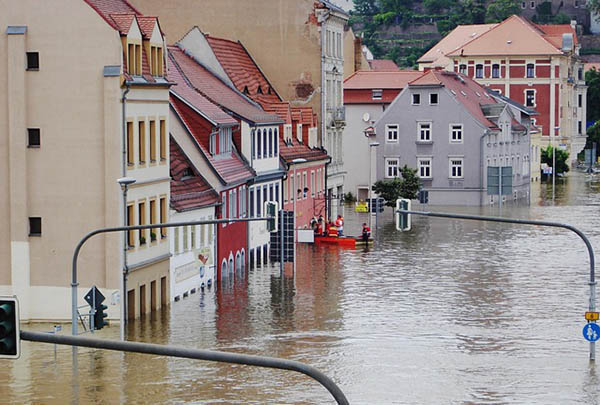
Year after year, natural disasters are increasing in frequency and intensity, causing devastating losses on a global scale.
Today, these events are the number one threat to the global economy. In 2023 alone, they caused almost 95 000 deaths and economic losses estimated at 380 billion USD,118 billion USD of which were borne by insurers.
For 2024, the figures as of December 5 are as worrisome as those for previous years. According to Swiss Re, climatic hazards would generate 310 billion USD in economic losses and 135 billion USD in insured losses in 2024. This means that, for the year just ended and for the fifth year running, the insured costs would well exceed the 100 billion USD mark.
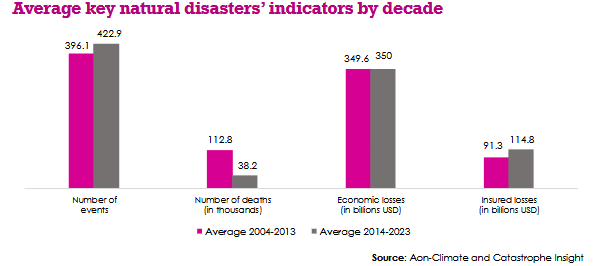
2014-2023: a decade of natural disasters
Natural disasters accounted for average annual economic losses of 350 billion USD over the 2014-2023 decade.
In terms of economic cost, 2017 was the most expensive year of the period, with 603 billion USD in losses. Three hurricanes Harvey, Irma and Maria of category 4 and above, on a scale of five, had devastated the US coasts, reaching for these three events alone a record bill of 292 billion USD in economic losses, including 93 billion USD sustained by the insurance market.
2019 reached a record of another kind, that is, the number of natural disasters in a single year, with 449 events, including 151 in Asia-Pacific, 143 in Europe, the Middle East and Africa, 85 in the USA and 70 in America (excluding the USA).
2023, with three earthquakes in Morocco, Turkey and Syria (62 272 deaths) and several heat waves affecting Western and Southern Europe in particular between July and September (15 000 deaths), recorded the highest number of human casualties of the 2014-2023 decade, at 95 000 deaths.
While this sad toll is higher than that of the average 2014-2023 decade, it is still well below the one recorded during the previous decade 2004-2013, during which three particularly catastrophic years 2004, 2008 and 2010 were reported.
- In 2004, the Indian Ocean tsunami alone claimed the lives of 240 000 people out of an annual total of 260 000,
- In 2008, Cyclone Nargis in Myanmar caused 84 537 deaths out of an annual total of 245 000 in addition to the disappearance of 53 836 other people,
- In 2010, Haiti's earthquake, measuring 7.3 on the Richter scale, left more than 220 000 people dead, 300 000 injured and 1.3 million homeless. Total loss of life in 2010 was around 255 000.
Read also | Top 10 most expensive natural disasters of 2024
Number of natural disasters, deaths, economic and insured losses: 2014-2024
| Year | Number of events | Number of deaths | Economic losses (in billions USD) | Insured losses (in billions USD) |
|---|---|---|---|---|
| At-end September 2024 | 273 | 10 204 | 310 | 135 |
| 2023 | 398 | 95 000 | 380 | 118 |
| 2022 | 427 | 32 000 | 355 | 151 |
| 2021 | 412 | 36 000 | 398 | 153 |
| 2020 | 440 | 23 000 | 335 | 122 |
| 2019 | 449 | 44 000 | 303 | 94 |
| 2018 | 438 | 28 000 | 350 | 125 |
| 2017 | 437 | 40 000 | 603 | 193 |
| 2016 | 411 | 25 000 | 338 | 76 |
| 2015 | 402 | 37 000 | 217 | 55 |
| 2014 | 415 | 22 000 | 221 | 61 |
Sources: Aon-Climate and Catastrophe Insight and Sigma
The 20 most expensive natural disasters: 2014-2023
Tropical cyclones are the costliest events of the 2014-2023 period, generating 478.3 billion USD in economic losses, 185 billion USD of which were borne by insurers.
In terms of costs and for the same period, floods come second in our ranking of natural catastrophe risks.
Europe and China are the two geographic zones most affected by floods. The latter caused 123 billion USD of damage, 14.6% of which was covered by insurers (18 billion USD).
Earthquakes rank third in terms of losses for the 2014-2023 period. Two major earthquakes in Japan in 2016 and in Turkey-Syria in 2023 caused economic losses estimated at 130 billion USD.