English
 Français



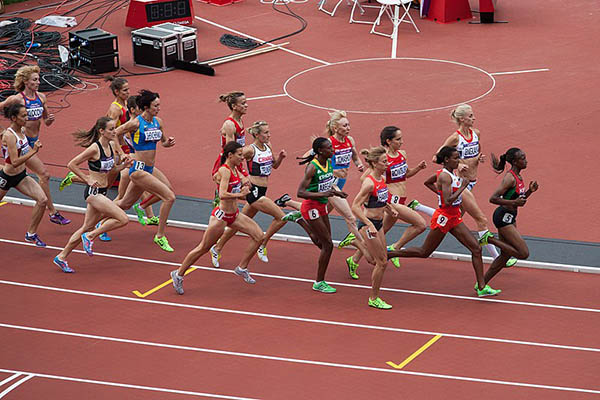
The Summer Olympic Games are an international multi-sport competition held every four years in a different country. After Tokyo 2021, this sporting event will be held in Paris, France from 26 July to 11 August 2024.
For each edition, a long preparation process, involving many stakeholders and partners including insurers, is carried out in the backstage and away from the spotlights and the medals.
History of the Olympic Games
The history of the Olympic Games dates back to ancient times, to the Peloponnese (1) in Greece some 3000 years ago. At that time, sporting competitions were organized in Olympia (2), hence the name Olympic Games. The four-year period represented the dating system of the time: timing was done in Olympiads (3) and not in years.
The 1st Games of the modern era were held in Athens in 1896, two years after the founding of the International Olympic Committee (IOC) in 1894. Since then, the event has been organized every four years by the IOC in a different country. The Olympic Games were cancelled in 1916, 1940 and 1944 due to world wars. In 2020, the Tokyo Games were postponed for a year, due to the Covid-19 pandemic.
(1) Greek Peninsula
(2) A religious center in ancient Greece, located in the Peloponnese
(3) Four-year period between two successive celebrations of the Olympic Games
The Paris 2024 Olympic Games in figures
For this XXXIII Olympics, Paris has gone to great lengths to welcome:
- More than 15 000 athletes from 206 countries
- 329 sporting events in 48 Olympic and Paralympic disciplines, organized at 39 competition venues
- Up to 20 simultaneous competitions
- Over 600 000 spectators for the opening ceremony
- More than 40 000 people, staff, employees and partners
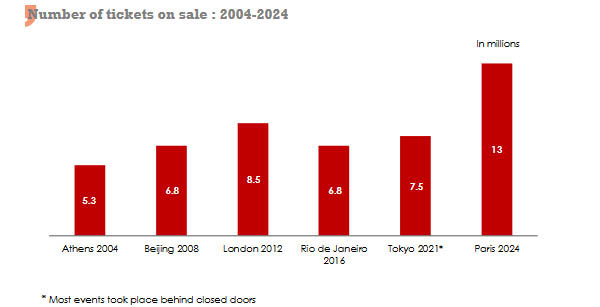
- Nearly 15 million spectators expected for the Olympic and Paralympic Games. A total of 13 million tickets made available to the public, 8 million of which had already been sold by mid-April 2024
Olympic Games: financial challenges and risk management
As a large-scale sporting event, the Olympic Games mobilize considerable financial and human resources.
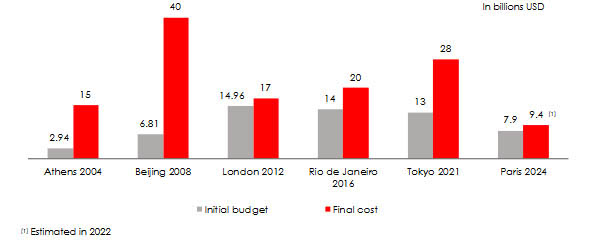
The sheer size of the Games poses challenges in terms of budget, organization and risk management. The final cost of organization always exceeds the initial budget.
This gap, which is systematic for all Olympiads, translates into an average overspending of 167%, and has been the case since the 1968 Olympic Games in Mexico.
Olympic Games: rising organizational costs 2004-2024
With a total cost of 40 billion USD, the 2008 Summer Olympic Games in Beijing were the most expensive event in Olympic history. To promote the event, China embarked on titanic infrastructure development and renovation projects.
These included the construction of sports facilities, urban development projects, roads, freeways, the world's largest airport terminal (Beijing) and new subway lines.
Budget and projected revenues for the 2024 Paris Olympic Games
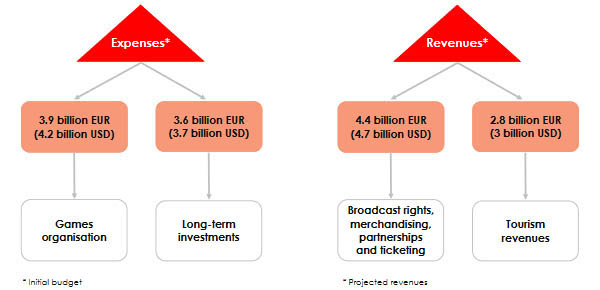
The initial budget for the Paris Olympics has risen from 7.5 billion EUR (7.9 billion USD) in 2017 to 8.8 billion EUR (9.4 billion USD) in 2022. More recent estimates set the figure as high as 12 billion EUR (12.9 billion USD).
Increase in the Olympic Games insurance budget: 2004-2024
This upward trend in spending can also be seen in the budgets allocated to Olympic Games insurance. From one edition to the next, the price of insurance coverage soars due to the increase in risks and unforeseen events:
- natural disasters,
- civil unrest,
- attacks,
- pandemics,
- cyber-attacks,
- etc.
Such catastrophic risks have become serious reasons for cancelling, postponing or suspending games.
Furthermore, the policies underwritten and the values insured vary considerably according to the geopolitical context and specific risks of each host country.
For example, the Tokyo Games in 2021 generated a record loss of 2 billion USD for insurers. According to analysts at the Jefferies financial group, this amount is the highest in Olympic history, due to the major economic impact of the Covid-19 pandemic.
Originally scheduled for summer 2020, the event was postponed for a year and held behind closed doors. The revenue shortfall from ticket sales and sponsorship reached record levels.
Olympic Games: insurance budget and maximum compensation limit
In millions USD
| Olympic Games | Insurance budget (1) | Maximum compensation limit |
| Athens 2004 | 6.8 | 170 |
| Beijing2008 | 9.3 | 415 |
| London 2012 | NA | 100 |
| Rio de Janeiro 2016 | 14.38 | 200 |
| Tokyo 2021 | 17.036 | 2 000 |
(1) Premiums paid by the International Olympic Committee for cancellation risk only
NA: Not available
Role of insurance in the Olympic Games
The need to insure the Olympic Games is relatively recent. It was only in 2004, when the 28th Olympiad in Athens were held, that the International Olympic Committee (IOC) had underwritten cancellation insurance to guarantee its operational viability.
In fact, the Committee wanted to limit its financial exposure in case of a major event leading to the cancellation or interruption of the Games.
For insurers, the risks associated with large-scale sporting events fall into the category of "special risks". Several lines of business are affected: event or cancellation insurance, third-party liability, property damage, Directors and officers (D&O) liability, etc.
For each edition of the Olympic Games, a list of several hundred risks is drawn up by the partners: organizers, brokers and insurers, with nearly a quarter of the risks identified being traditionally covered by insurance.
Generally, three main types of plans are necessarily underwritten by the organizers of a world-class sporting event:
- A third party liability policy. It drains a large part of the Olympic Games insurance budget. This policy covers bodily injury as well as material and immaterial damage caused to third parties. The Olympic Games, with their huge crowds and complex infrastructures, expose organizers, participants, delegations and spectators to multiple risks: injury, attack, natural disaster, negligence, social unrest, stampedes, etc.
- Event or cancellation (ticketing) insurance: This covers the total or partial cancellation of an event. This cancellation is caused by the occurrence of an unforeseen event: a major natural disaster, civil unrest, acts of terrorism, a global pandemic, a large-scale cyber-attack, etc.
This type of contract often comes with several exclusion clauses.
Since 2010, ticketing insurance has also covered the cost of television rights. This type of insurance can also cover the reimbursement of damage caused to sponsoring companies.
- Insurance for athletes. It mainly covers repatriation costs and medical care for athletes in the event of injury. As a general rule, there is no compulsory insurance for amateur or professional athletes. In principle, organizers are the ones required to underwrite group insurance policies covering third party liability (the legal obligation to compensate for damage caused to others) for all participants in a sporting event.
Top-level athletes generally benefit from disability or loss-of-earnings coverage. The athlete's federation or club is responsible for providing coverage against work-related accidents and illnesses.
Athletes can also underwrite personal insurance to cover damage that is not caused by a third party.
Other risks
To the three main schemes mentioned above, there are other risks to be added such as boycotts and cyber-attacks, threats just as feared as the risks of terrorist attacks and stampedes.
- The cyber threat has become a reality for sports event organizers given the upsurge in malicious attacks. According to Hiscox, Lloyd's syndicate, due to their importance and international media reach, the Paris Olympics are likely to be accompanied by four billion cyberattacks. The last Olympics in Tokyo sustained almost 450 million attacks. The London Games in 2012 and the South Korean Games in 2018 were also disrupted by the deployment of malware.
The aim of such acts is to make financial gains, disrupt the progress of competitions or tarnish the image of the host country. - The boycott risk first appeared in 1980 at the Moscow Olympic Games. This edition, boycotted by the United States and 65 other countries, resulted in significant losses for television channels.
Allianz, insurer partner of the Paris Olympic Games
Allianz is the partner of the Olympic Games for the 2021-2028 period. As the official insurer of the International Olympic Committee, the company is taking on a large proportion of the risks associated with this event, such as damage to various sports facilities, cybersecurity and the disruption of certain activities.
The insurer offers ticket cancellation insurance. This insurance enables ticket holders to obtain a refund in the event of unforeseen circumstances preventing them from attending the competitions, such as an accident, illness or professional constraint.
For the 2024 edition, over 13 million tickets are on sale, compared to 8.5 million in London in 2012.
Key dates
- 1894: Creation of the modern Olympic Games by 12 countries at the Sorbonne Congress
- 1896: Organization of the first Olympic Games in Athens
- 1900: Women allowed to take part in the Paris Olympics
- 1904: Anthropological days at the Saint Louis Olympic Games
- 1913: Pierre de Coubertin designs the Olympic rings to represent the union of the 5 continents
- 1916: Cancellation of the Olympic Games due to World War 1
- 1920: Exclusion of Germany and Austria from the Antwerp Games due to their role in World War 1
- 1924: Launch of the first Winter Olympics in Chamonix
- 1936: Berlin Olympics, under Nazi rule
- 1940 et 1944: Olympic Games cancelled due to world war
- 1956: Boycott of the Melbourne Olympics for political reasons (Franco-British invasion of the Suez Canal and Soviet intervention in Hungary)
- 1960: Organization of the first Paralympic Games in Rome, a post-Olympic event
- 1964:
- South Africa excluded from the Games because of its apartheid policy.
- Return in 1996
- 1968: Hostage-taking and death of 11 athletes during the Munich Olympics
- 1972: Prise d'otages et décès de 11 athlètes pendant les JO de Munich
- 1976: Boycott of the Montreal Olympics by the majority of African countries, in protest against the participation of New Zealand, a country supporting South Africa's apartheid policy
- 1980: Boycott of the Moscow Olympics by some fifty countries, including the United States and most European countries
- 1984: Boycott of the Los Angeles Games by the Communist bloc, initiated by the USSR
- 1993: Adoption of the Olympic Truce concept by the International Olympic Committee and the UN
- 1996: Murderous attack at the Atlanta Olympic Games, causing two deaths
- 2020: Tokyo Olympics postponed for a year due to the Covid-19 pandemic
- 2024: Participation of Russian and Belarusian athletes under a neutral banner