English
 Français



Wildfires are one of the world's most dreaded threats. Every year, millions of hectares of woodland and vegetation go up in smoke, affecting not only ecosystems and biodiversity, but also populations, urban environments, infrastructures and the entire economic framework.
These catastrophic events, whether man-made or natural, are now exacerbated by global warming, becoming more frequent, more widespread and more destructive.
Frequency and intensity of Wildfires
According to the World Organization for the Protection of the Environment, fires cause the global destruction of almost 350 million hectares of forest per year, or more than 11 hectares per second. The Amazon rainforest, vital to the planet, is particularly hard hit, with nearly 3% of its surface area, or 85 500 km², having been lost to fire in the last ten years.
The situation in Africa, mainly in Angola and the Democratic Republic of Congo, is even more dramatic. These two countries lose an average of 800 000 km² of woodland per year.
Over the last two decades, from 2003 to 2023, forest fires have more than doubled worldwide. Global warming due to human activity is undoubtedly the main cause of this worsening phenomenon.
According to the study “Increasing frequency and intensity of the most extreme wildfires on Earth”, published in June 2024 in the journal Nature Ecology & Evolution, the planet is facing increasingly intense and frequent wildfires every year. During the period 2003-2023, 2018 was the worst, although subsequent years have also been marked by intense wildfires.
2024 marks a new record for forest fires, particularly in the Brazilian Amazon. Sadly, 2025 began with the California wildfires, where from 7 to 31 January, a series of devastating blazes swept through the Los Angeles metropolitan area, particularly affecting the wealthy neighborhoods of Palisades and Eaton.
Read also | Major wildfires: 2015-2024
Mapping of the areas hardest hit by wildfires
Although media attention is often focused on fires in the Amazon and the USA, Africa is also severely affected by forest fires.
It is estimated that 120 million hectares of African rainforest have been destroyed over the last 30 years, mainly as a result of slash-and-burn agriculture, an age-old practice.
Around the Mediterranean, some 50 000 fires a year are devastating between 700 000 and 1 million hectares of forest.
Europe and Canada are not spared either, with 60 000 forest fires a year in the former region and around 8 000 a year in Canada.
Democratic Republic of Congo
On average, the DRC is ravaged by 113 000 wildfires every year. Deforestation is mainly due to shifting agriculture and charcoal production.
Insured losses due to fires amounted to 10.695 million USD in 2022.
Angola
The situation in Angola is just as worrying as in the Democratic Republic of Congo. An annual average of 78 800 fires have resulted in the loss of vast areas of forest.
Hunting, clearing for agricultural purposes and livestock farming are the main causes of fires.
Insured losses due to forest fires reached 25 431 million USD in 2022.
Zambia and Central African Republic
Forest fires in Zambia and the Central African Republic are mainly caused by human practices, such as slash-and-burn agriculture and the use of fire in bushmeat hunting.
In Zambia, the wildfires season generally starts at the end of June and lasts around 15 weeks, with an annual average of 52 421 fires.
In the Central African Republic, the fire season starts in mid-November and lasts around 14 weeks, reaching an annual average of 36 325 fires.
The Amazon rainforest
Covering a vast area of 550 million hectares and shared by nine countries, the Amazon is known as the “lungs of the Earth”. Increasingly dry periods between July and August are responsible for numerous fire outbreaks during this period.
Russia
Every summer, Russia is bound to face vast forest fires, particularly in Siberia and the Far East, where climate change is exacerbating early heatwaves and thunderstorms, accelerating the onset of fires.
With an annual average of 27 567 fires, the fire season, which lasts around 18 weeks from the end of April, is becoming a growing threat, including to inhabited areas.
Russian policy, which favors limited intervention for cost reasons, is drawing criticism from environmentalists.
Les Etats-Unis
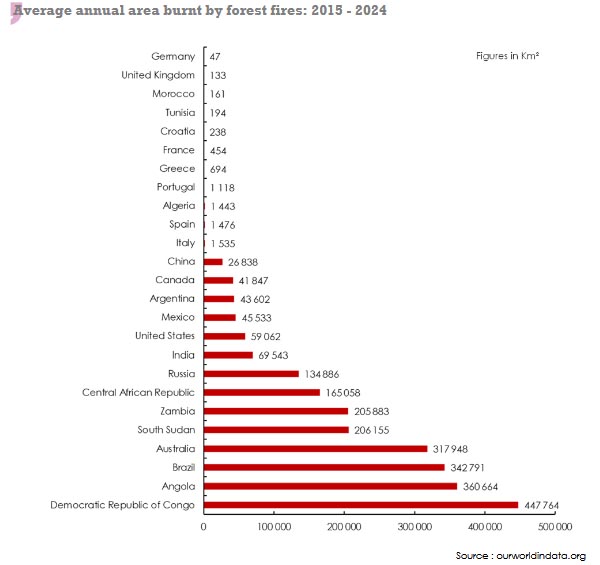
With an annual average of 13 941 fires and a burned area of around 59 062 km², forest fires in the USA, particularly in California, the Northwest and Alaska, are extremely costly.
The peak wildfire season generally begins in May and lasts around 22 weeks. Property destruction, firefighting costs, economic disruption and environmental damage cause considerable losses.
Climate change, urbanization of at-risk areas and dry vegetation encourage the spread of fires, amplifying costs for communities, insurers and the economy in general.
As a reminder, the whole country is frequently hit by extreme natural disasters (droughts, fires, floods, winter storms, tornadoes, hurricanes). In 2024, the aggregate cost of these phenomena was 182.7 billion USD, double the figure for 2023.
Canada
In Canada, forest fires are the result of a combination of natural (mainly lightning) and human causes. Every year, the country faces an average of 5 079 fires, destroying some 41 847 km² of forest.
Climate change plays a key role in these disasters, exacerbating conditions conducive to fires, with hotter, drier summers.
The peak wildfires season generally begins in mid-May and lasts around 14 weeks, particularly affecting British Columbia (a province on the Pacific coast), Alberta (in the west of the country) and the Northwest Territories.
In 2023, Canada experienced its worst forest fire season ever, with 6 600 fires and 18 million hectares of burned forest. Economic losses were estimated at 465 million USD, while insurers were set back 310 million USD.
Australia
Australia is one of the countries most affected by fires. Damage is considerable, with an annual average of 36 758 fires and an annual loss of surface area of around 317 948 km².
The peak fire season generally begins at the end of July and lasts around 23 weeks. These fires have many causes, ranging from dry storms (1) triggering bushfires to human activities.
The consequences are devastating, both environmentally and economically, with major losses in biodiversity and high firefighting and reconstruction costs.
(1) A dry thunderstorm is a meteorological phenomenon in which lightning and thunder occur, but with little or no precipitation on the ground.
Maghreb countries
Wildfires have been rising in recent years in the Maghreb, particularly affecting Algeria, followed by Tunisia and Morocco. Climatically, the region suffers from intense heat waves and prolonged drought, exacerbated by climate change, creating ideal conditions for fires. Hot, dry winds, such as the sirocco in Algeria, fan the flames and spread fires rapidly.
Over the past decade, Algeria has recorded an annual average of 1 443 km² of burnt area and 513 fires. These alarming figures underline the need to step up fire prevention and control efforts in the region.
With 52 and 39 fires on average, Tunisia and Morocco respectively account for 194 km² and 161 km² of forest lost each year.
European countries
In 2023, the European countries around the Mediterranean - France, Spain, Greece and Italy - were ravaged by fires on an exceptional scale. These disasters were mainly attributed to a combination of extreme weather conditions (heat waves, strong winds), worsening climate change and local conditions specific to each country.
In the same year, Europe saw 177 000 hectares up in smoke, compared with an annual average of 128 000.
In France, 21 000 hectares were destroyed, exceeding the annual average of 13 000 hectares.
Spain recorded 69 000 hectares burnt, approaching the annual average of 80 000 hectares.
Greece saw a sharp rise in fires, from 700 hectares burnt to over 37 000 hectares in just a few days.
Italy, in particular Sicily, Puglia and Calabria, was also hit by major fires.
Read also | Wildfires: causes and consequences