English
 Français



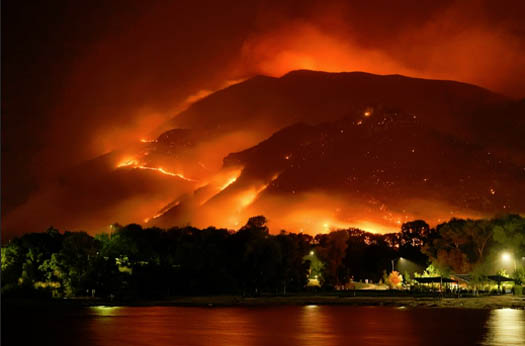
For two decades, forest fires have posed an increasingly serious threat to people around the world. Before 2015, this risk accounted for only 2% of annual insured losses related to natural disasters. That percentage is 10% in 2026.
From 2000 to 2025, wildfires caused 302 billion USD in economic losses, 148 billion USD of which was borne by insurers. In 2025 alone, economic losses resulting from such events amounted to 63 billion USD, including 42 billion USD covered by insurers.
Read also | The largest wildfires of 2026
Forest fires: scale and damage
According to Swiss Re, insured losses resulting from wildfires are growing at an average annual rate of approximately 12%. This rate, which applies to the period from 1970 to 2025, represents the highest growth rate among all natural hazards.
The year 2025 has perfectly illustrated this trend, with the Los Angeles (Palisades and Eaton) fires, alone, resulting in 58 billion USD in economic losses, 41 billion USD of which was borne by insurers, setting a new record for forest fires.
Globally, the first half of 2026 proved to be significantly more favorable.
Unfortunately, this break did not last. Heat waves beginning in June 2026, combined with persistently dry conditions, led to a resurgence of wildfires in several regions around the world, particularly in France and Spain. Fires also affected North Africa, Canada, and the United States.
Forest fires: factors contributing to increased risk
Three main factors are responsible for the increased risk of wildfires.
A warmer and drier climate
Rising temperatures, insufficient rainfall, and successive heat waves are drying out vegetation, thereby creating conditions conducive to the outbreak and spread of fires. Global warming has accelerated significantly since 1980.
Each decade has been warmer than the previous one, with average temperatures rising from +0.23 °C to +0.99 °C between 1980 and 2025, an increase of nearly one degree over 40 years.
Increase in the value of insured property
Urbanization and the expansion of construction in high-risk areas automatically increase the potential for damage.
In the United States, the number of homes located in areas at risk of wildfires doubled between 1990 and 2023.
In Europe, approximately 270 000 people live in areas affected by at least one fire between 2019 and 2023. In Italy, more than 127 000 people are at risk of such an event. In Portugal and Greece, this proportion of vulnerable people accounts for 0.40% and 0.39% of the national population, respectively.
Human activity
Human activity is the cause of a large proportion of wildfires, particularly through the burning of agricultural residues, land clearing by fire, campfires, certain construction activities, and acts of arson.
In Europe, approximately 96% of wildfires are linked to human activities. In the United States, this proportion accounts for about 85% of wildfire outbreaks.
Read also | Wildfires: causes and consequences
Location of mega-forest fires in 2026
The 2026 fire season was particularly intense on the American continent. Two countries alone, Canada and the United States, accounted for more than 7.3 million hectares burned. South America was no exception, with tens of thousands of hectares being destroyed, particularly in Chile and Argentina.
In Europe, as detailed below, it was the historic mega-fires in Greece, Spain, and France that made headlines. Oceania, on its part, sustained violent, rapidly spreading bushfires.
North Africa was not spared. In Algeria, the fires particularly affected the northern regions of the country (Jijel, Bejaia, Tizi Ouzou). In Morocco, the fires of 20 July 2026, ravaged 1 850 hectares, while in Tunisia, more than 240 hectares burned in the month of July alone.
Read also | Southern Europe fires: An unprecedented disaster